

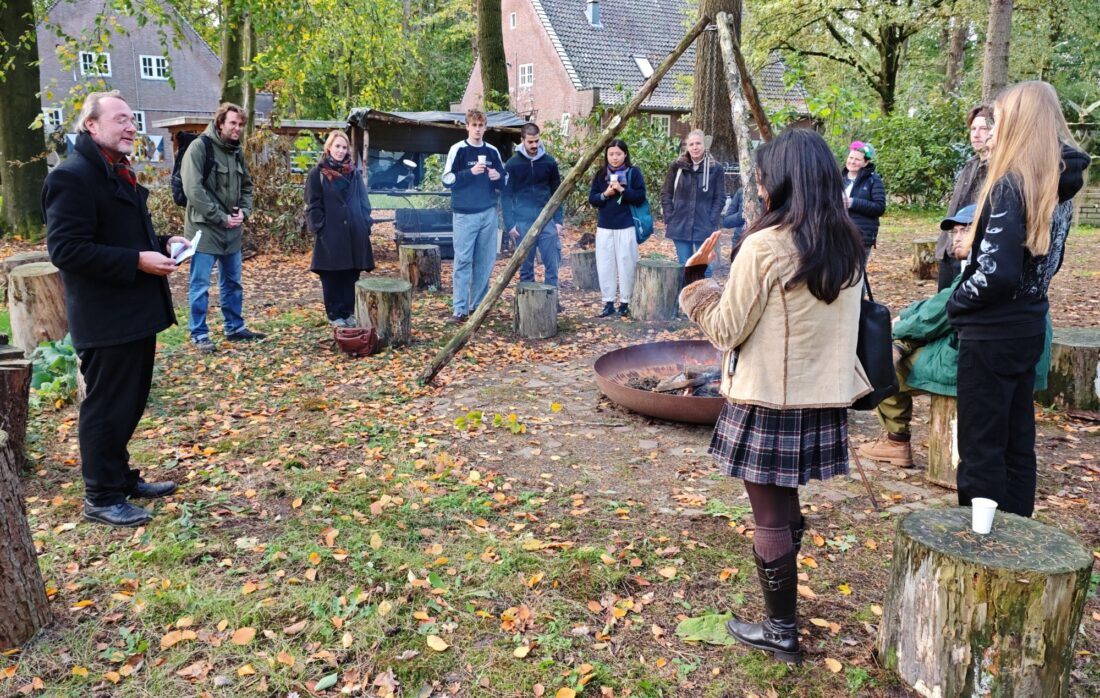
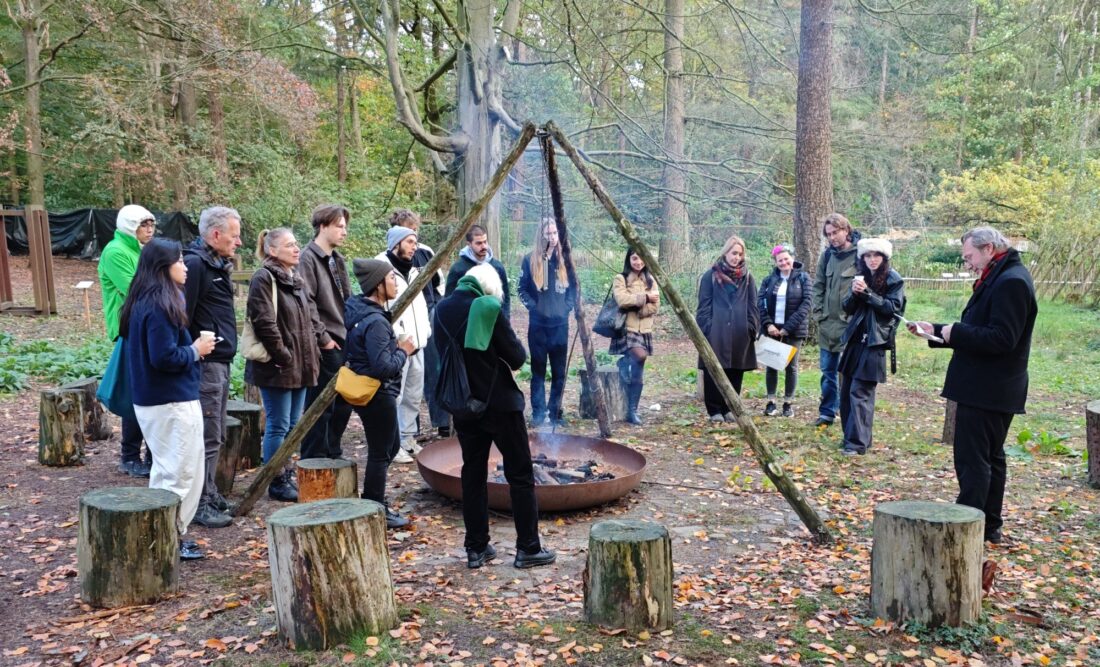
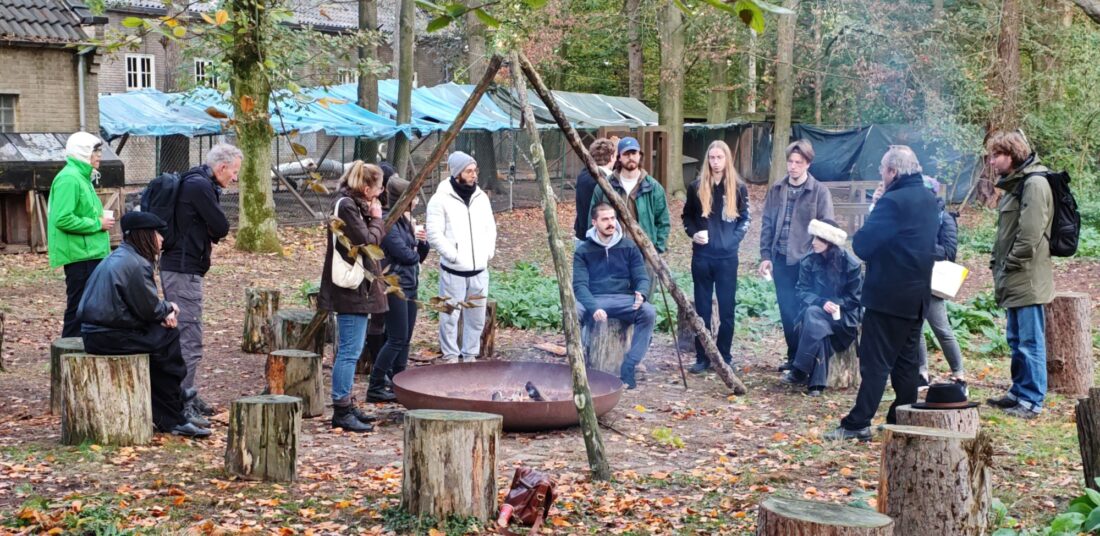
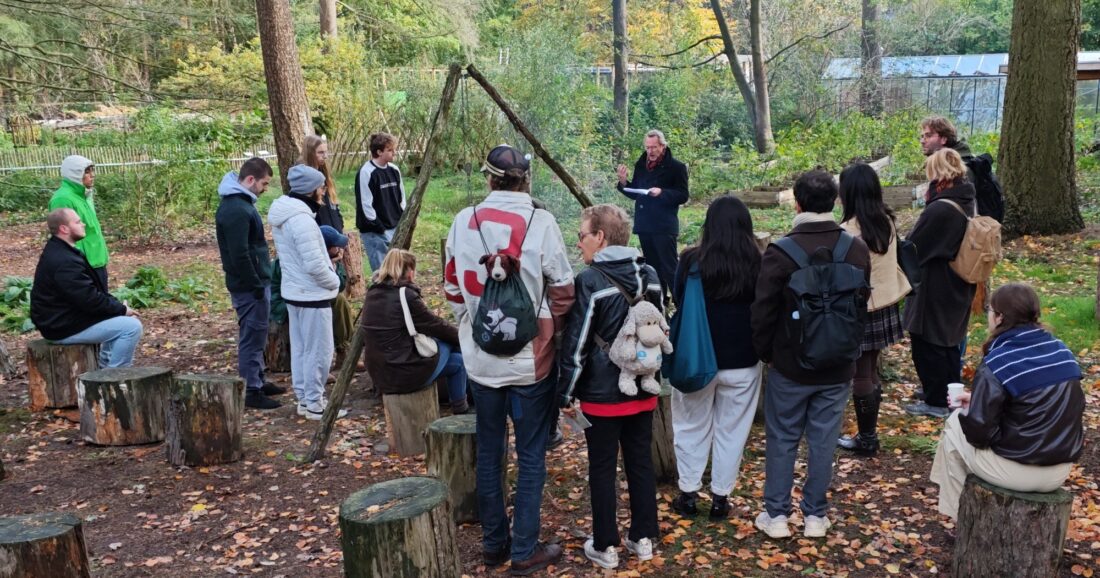
During the final weekend of Dutch Design Week 2025, BioArt Laboratories and Dr. Landeweerd—a renowned philosopher in the fields of life sciences, science communication, and ethics—organized the Roots & Routes campfire debate. The familiar format of a conversation around a warm campfire once again brought people together, accompanied by pepernoten, coffee, and tea. A philosophical café and debate in one, offering an inspiring afternoon.
The debate opened with an introduction to how humans perceive deep time through the naming of geological epochs: from the emergence of complex life in the Pliocene and the development of early humans in the Pleistocene, to the relative stability of the Holocene, marked by the rise of agriculture and complex societies. At the beginning of the 21st century, chemist Paul Crutzen introduced the concept of the Anthropocene to describe a new epoch in which human activity has become a dominant geological force, profoundly shaping climate, ecosystems, and the planet. While this framework makes both the scale of human impact and its consequences visible, it can also reinforce dystopian narratives that emphasize destruction without offering pathways for action. Such perspectives, although critical, may limit imagination and hinder constructive engagement. This highlights the need for alternative approaches that combine critical awareness with perspectives of restoration, renewal, and creative reorientation.
The debate then introduced the concept of the Symbiocene, as proposed by Glenn Albrecht: an era defined by mutually beneficial relationships between humans and all other life forms, in which symbiosis—rather than human greed—serves as the organizing principle. BioArt Laboratories translates the Symbiocene into practice, as seen in the exhibition: experimental work with materials, spatial experiences, and collaborative formats. Artists and scientists literally work with fungi, bacteria, plants, water flows, and minerals—biological agents that are approached not as materials, but as partners. Many installations emphasize co-creation rather than the mere use of nature; materials are grown, cultivated, or regenerated rather than extracted. In this sense, the Symbiocene functions as a poetic-operational compass that guides collaboration across species, disciplines, and timescales, without being treated as a fixed doctrine. It opens up new perspectives and methods, while raising the question of how we relate to these approaches. Through four thought-provoking statements, visitors—both makers and audience—actively engaged in discussion in a House of Commons-style format, with both sides of each statement defending their position. Under the guidance of Dr. Laurens Landeweerd, the debate proceeded smoothly, characterized by respect, sharp rhetoric, humor, and mutual understanding. The following statements were addressed:
When humans collaborate with living organisms in art, the boundary between maker and medium becomes blurred. How do we define authorship in such contexts? Can a fungus or plant be considered a “co-creator,” and what does this mean for the valuation of art? Some argued for co-creation, stating that ownership cannot be extended to the organism itself. Others emphasized that authorship lies in the idea—the conceptual essence of the work—which remains with the artist.
Dystopian visions within the Anthropocene confront us with the paradox that imagining decline may be necessary in order to imagine flourishing. Can the visualization of ecological collapse stimulate positive change, or does it instead lead to fatalism? How can artists warn while still preserving hope? Some argue that such narratives are necessary to drive innovation, as crises have historically led to progress. Others caution that they may also be demotivating and lead to apathy and resignation.
Representing ecosystems through metaphors in art can simplify or distort the complexity of the living world. Is simplification inevitable in making concepts accessible? When does a metaphor enhance understanding, and when does it mislead? For some, simplification is necessary to communicate complex ideas to a broad audience. Others argue that it can lead to misinterpretation, as the message may be understood differently than intended.
Concepts such as the Symbiocene are sometimes seen as utopian and may divert attention from urgent ecological realities. Does utopian thinking inspire action, or does it hinder practical solutions? Can speculative frameworks and pragmatic approaches coexist? Critics argue that such concepts remain largely philosophical with limited direct societal impact. Others see them as frameworks for thought and sources of inspiration from which new ideas can emerge at the intersection of art, life sciences, and innovation.
The debate was open so that visitors and artists could join at any time. The mild weather, natural surroundings, and sense of togetherness around the campfire contributed to a meaningful and memorable closing of Dutch Design Week at BioArt Laboratories.